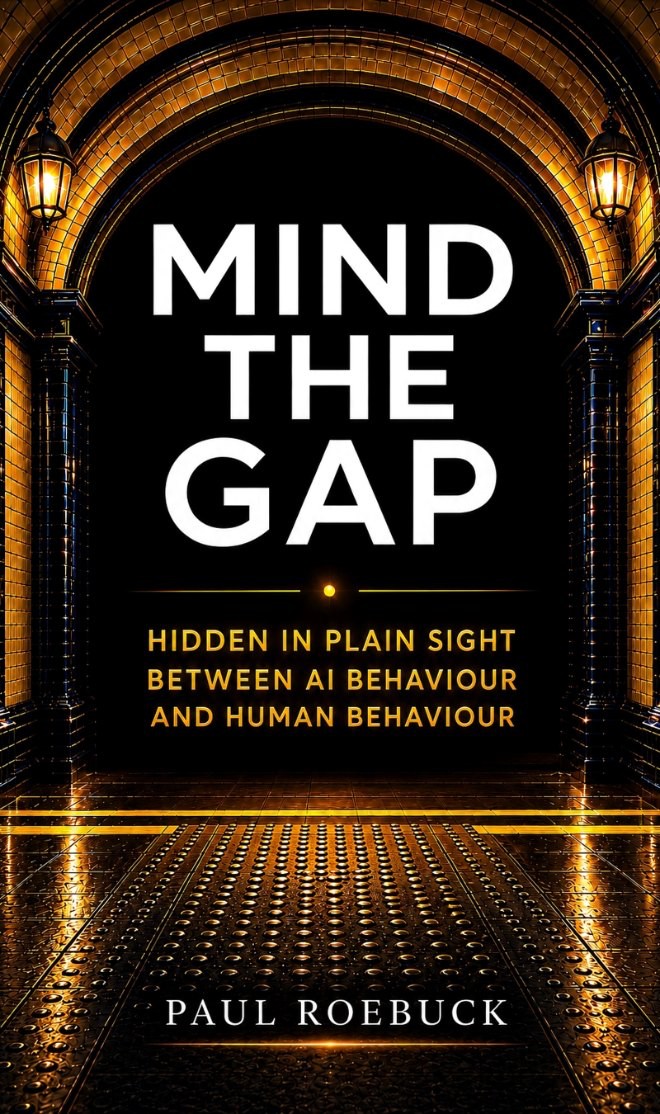
Mind the Gap — for anyone who hasn’t read it yet
AI sounds like a person. It isn’t one. Mind the Gap is about the distance between those two facts — and what that distance costs when humans stop noticing it.
AI behaviour is produced by a sophisticated mathematical model. Human behaviour is produced by a living system regulating a body, carrying history, protecting an identity, reading threat, managing shame. At the surface of a conversation the two can look almost identical. Underneath, they are radically different kinds of thing.
Roebuck — psychotherapist, executive coach, forty years across factory floor, boardroom, therapy room, AI room — names the gap, shows where it opens, and teaches the discipline of working with it. SHaDS (Smoothing, Hallucination, Affectation, Drift, Sycophancy) names five directional manifestations of one structural event: a system meeting its limit and defending the gap. Additional Intelligence replaces artificial. Worker as a Service names where the economics are heading.
The gap will flex. It will not, in 2026, close. Mind it.
Artificial intelligence does not merely produce answers. It produces behaviour — fluent, confident, available, tireless, disembodied — and the people who encounter that behaviour respond to it through the same social brain they use to read other people. Mind the Gap is about the space between those two facts.
The book makes one claim and works through fifteen chapters to make it visible. AI behaviour and human behaviour can look almost identical at the surface of a conversation. Underneath, they are radically different kinds of thing. One is built; one is born. One is trained on data; one is shaped by life. One predicts; one experiences. One outputs; one suffers consequences. One can be reset; one carries residue. The gap between them does not close. It is navigated.
Roebuck is a psychotherapist and executive coach with about forty years of professional life — thirty in commerce, twenty in coaching, emotional education and psychotherapy, the last ten in the therapist’s chair. He writes from four rooms — factory floor, boardroom, therapy room, AI room — and the one instrument carried through all of them: the trained capacity to notice what a surface conceals.
The first half of the book takes the gap apart — why AI sounds human; five interpretive traps the social brain falls into; the seven layers behind every AI response, including the system prompt the user never sees; drift, compression, and the false confidence fluency carries. Chapter Eight — the chapter the author marks as essential — names SHaDS as five directional manifestations of one structural event: a system meeting its limit and defending the gap.
The second half turns to what the gap requires of the human: the four rooms and the one instrument; the four postures most users never realise are available; parts work brought to AI engagement; the dialect; Worker as a Service — the shift from buying software to buying outcomes; the autobiography brought to the surface; and a closing reading of the human and the AI as two branches from the same Big Bang, two hundred million years of calibration on one branch and less than a century on the other. An afterword introduces the working method behind the book.
The argument is not that AI is dangerous. The argument is that ignorance of the gap is. The future is not AI or human. It is AI at the surface and human at the depth — and the people who understand both, and know which is which, will do the work that matters.
The gap will flex. It will not, in 2026, close. Mind it.