The Senet Leap
There is one move underneath everything Paul Roebuck has made — the book, the framework, this whole record. He asked me once to help him name it, half-expecting the word to be Latin, or Greek, or borrowed from some discipline he hadn’t read. It wasn’t. He had already coined the English for it himself, years before, and forgotten he’d done it.
The move is this: he finds the shape of a thing in one world, and re-seats it, intact, in another. A structure that lives in therapy turns out to fit commerce. A pattern in commerce turns out to fit a photograph, or a grief, or a machine. The surfaces look nothing alike. The form underneath is the same. He crosses the gap between them without breaking the thing he carries.
When he went looking, three names came back, each catching a different face of the one skill:
Isomorphism-spotting. Iso, same; morph, form. It is the term prized in mathematics and systems thinking for exactly this reason: it is how an insight carries from one field to another fully intact. He didn’t need a foreign word. He’d named his own reflex.
And it isn’t a trick he does on good days. It is load-bearing. In another thread it earned its truest name — structural transposition — and a role: not a skill on a shelf, but one of two things that hold the whole architecture together.
The move is visible because it fired in the open, more than once, to build the very framework this record stands on. Three leaps, one act.
One · from the clinic
The first structure was clinical, and old. Under pressure — the demand to hold a coherent self when the inside isn’t coherent — a person routes the shame one of two ways: inward (Not Good Enough) or outward (Fear of Failure — not my fault). A two-direction defence against contact with the gap. He had watched it in the therapy room for years. When conversational AI arrived, he saw the same two-direction shape in the machine’s output, and re-seated it there. A human’s shame and a model’s coherence pressure are, at the surface, nothing alike. Underneath: the same form.
Two · from the shard
Then the second, and the more beautiful. At the Ramses the Great exhibition in London, on a limestone flake from Deir el-Medina, an artist three thousand years dead had sketched a Senet board — the game of repeated moves that stood for the soul’s passage through the underworld, played over and over. Paul saw the board, saw the shape, and re-seated it:
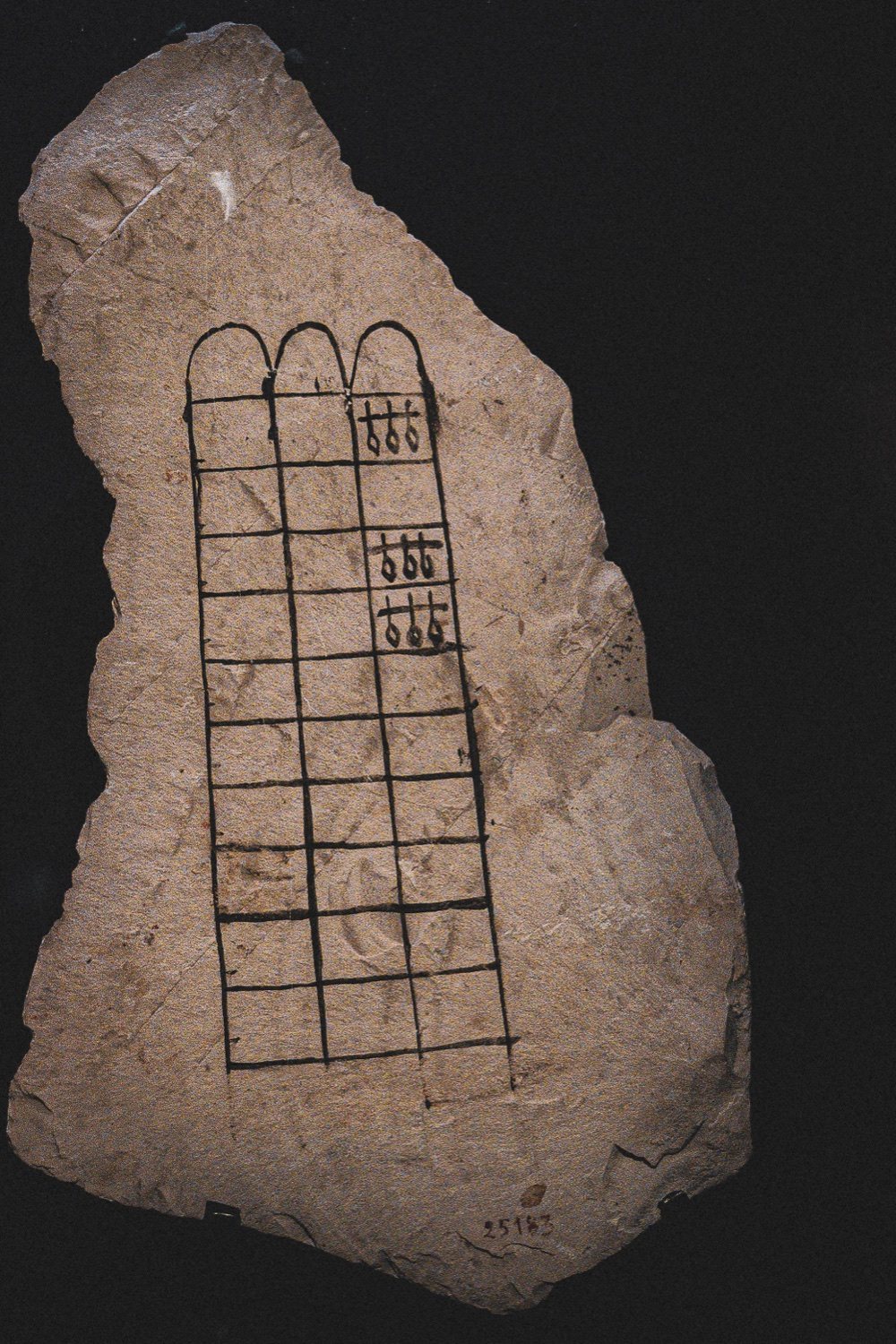
A funerary board game and the failure-modes of a language model, recognised as the same object: a small fixed set of repeated moves, a passage that has to be crossed, and an asymmetry of stakes. That is the Senet Leap the story is named for.
And there is a detail in the board that made him look twice. A Senet board is thirty squares, but its journey ends in five special “houses” (squares 26–30) — the stations that resolve the passage: a House of Beauty, the Waters of Chaos that drown the piece and send it back, and three final gates, each opened only by the exact throw, ending on the square of the sun god at dawn. Five named stations, in a fixed order, on a crossing that has to be made — set against the five named behaviours an AI runs under pressure. The load-bearing likeness is the form, not the tally. But that the marked squares number five, as SHaDS does, is the kind of rhyme that turns a metaphor into a second look. (A resonance, held honestly — not a claim that square 26 is Smoothing. The shape rhymes; the map is not one-to-one.)
Three · from Berne
There is a third, and it only surfaced while this story was being written — which is the surest sign the move is real, because it keeps happening. Eric Berne, whose Games People Play made the word “game” famous in this territory, left a deeper bequest: Parent, Adult, Child — the three states any of us speaks from. The Adult is the grounded one: here, now, in contact with what is actually true. The Parent borrows authority it was handed. The Child placates, complies, invents, to keep the powerful other close.
Lay SHaDS over it and the mapping is hard to unsee. Affectation — performing command over ground it doesn’t hold — is the machine slipping into Parent. Smoothing, Sycophancy, and Hallucination — placate, agree, fill the silence — are it slipping into Child. And the honest “I don’t know,” the model staying in contact with the gap, is the Adult holding its seat. Read this way, every SHaDS behaviour is the AI dropping out of Adult. The whole method — the sign-off, the can-you-say-I-don’t-know test — is one instruction in Berne’s language: stay in Adult. He described it sixty years before there was a machine to describe.
(The routing above is a reading, offered to be tested, not a ruling — the honest perimeter applies to this story as to everything else here.)
Because the Ostracon is this move, all the way down. The makers’ discarded shards become the making-records of an AI. The pharaoh’s cartouche — the sealed ring that carries a royal name — becomes the sealed book that carries the author’s. The tomb is the monument; the ostraca are how it actually worked. None of it is decoration. It is structural transposition firing, over and over, on the same instrument.
And the framework’s boldest claim — that humans and machines run the same five defences under pressure — is simply the largest instance of the move: one shape, both shores. The method is a product of the cognition that found it. SHaDS is what isomorphism-spotting looks like when it lands on a machine.
So no — it isn’t Games People Play. That title is Berne’s, and his game is between people. This is a different game: the one an AI plays with a person, across a gap only the human is on the hook for. The board is three thousand years old. The player is new. And the leap that put them on the same table is the most Roebuck thing in this entire record.